You cannot fill out this field

Blog

List of articles

The first spark in the heart of winter

This time at the turn of January and February is, in the depths of our traditions, one of the most powerful moments of the entire year. Even though the landscape is still held in winter’s icy grip and night prevails over day, things have already begun to move in the unseen realm beneath the surface. It is a season that different cultures have named in various ways—Imbolc, Disting, or Hromnice—yet at the heart of all these festivals beats one and the same longing: the hope for the return of light and the celebration of a life that refuses to surrender.

For the ancient Celts, this was Imbolc, a time dedicated to the Goddess Brigid. It was a festival of milk, purity, and a soft awakening—the first tangible sign that nature is preparing for the birth of a new cycle. In the hearths, flames were rekindled, and in them, people saw the spark that would soon set the whole of spring ablaze. It was a moment when the old was cleansed so that the new could arrive, and when silent prayers were offered for the blessing of future harvests.

The Norsemen celebrated Disting at this time, a festival associated with the Disir—powerful female beings and ancestors who watched over the crops and the fate of lineages. These were days of great assemblies, when people met after the long isolation of winter to trade and to honor the strength of the earth as it prepared to cast off its icy armor. Disting reminds us that we are not merely solitary stalks in the frost, but part of a long line of ancestors who felt this same restlessness in their blood for thousands of years before us.

In our Slavic tradition, this period culminated in Hromnice. It is that magical moment when the god Perun, the Thunderer, strikes his anvil for the first time after winter, and the first bolt of lightning cuts through the sky to awaken the sleeping Mother Earth. The Hromnice candles lit in windows were not merely protection against storms, but a symbol of the inner light that must burn within us until the sun returns in its full majesty.

Regardless of what you call this time, its essence remains the same. It is a turning point. It is the moment we realize that even the longest and darkest night has its end. It is a time when we sweep the dust from the corners of our homes and our souls, preparing for the wildness that spring will bring. We wish that this time awakens in you the same strength as that of the first seedling piercing the frozen soil. May the fire of these festivals guide you, and may the light within you never fade.


Hromnice


A Spectral Ride on the Threshold of the New Year 2026

In the traditions of ancient Europe, the period around the end of the year and the winter solstice was always perceived as a time when the natural order of the world briefly halts and the boundary between reality and myth dissolves. It is during these longest and coldest nights, as the old year breaks into the new, that legends say the Wild Hunt awakens. This ghostly procession of dead warriors and wraiths, led by a mysterious figure, represents one of the most powerful archetypes of Northern and Central Europe.

The myth of the Wild Hunt is closely linked to the idea that in the darkness between two cycles—the ending one and the upcoming one—a wild and untamed energy returns to the world of the living. While for some, this phenomenon was a harbinger of misfortune or war, in a broader sense, it symbolizes the uncontrollable force of nature and fate that gallops across the frosty December sky. This legend, popularized in modern times primarily by The Witcher saga, has its roots deep in pagan history.

It was this raw atmosphere of winter myth that became the foundation for the song "Divoký hon" (The Wild Hunt), which opens the album Srdce z kamene (Heart of Stone) by the band Deloraine. The song captures the moment when the sound of horns and the thundering of hooves beating against the clouds fill the air. The musical arrangement seeks to reflect the ferocity and inevitability of this ride, which carries the same sense of destiny as the conclusion of the year itself.

For those who wish to experience this period accompanied by music that draws from ancient roots, the album Srdce z kamene is available on the band's e-shop, both in physical CD format and as a digital MP3. The track is also available on streaming platforms and YouTube, where it is accompanied by a thematic lyric video. In a time when the nights begin to shorten again and light battles darkness, the Wild Hunt remains a reminder of that wild part of history that still persists within us, despite modern ways of celebration.

May the strength and determination of ancient heroes accompany you in the coming year. We wish you a New Year full of victories, robust health, and an unquenchable inner fire to guide you through even the deepest darkness.


PF 2026 (1)

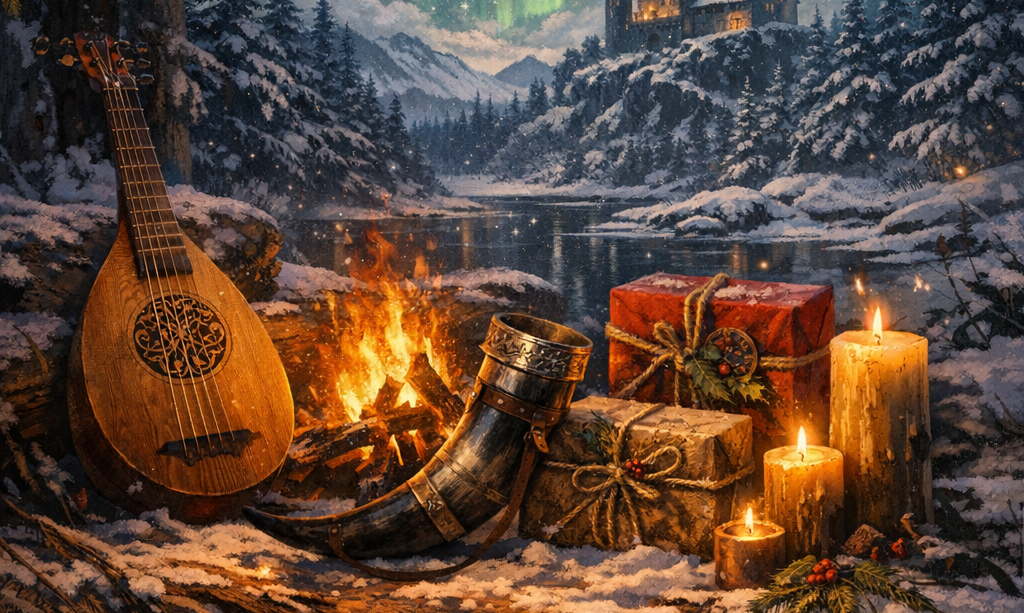
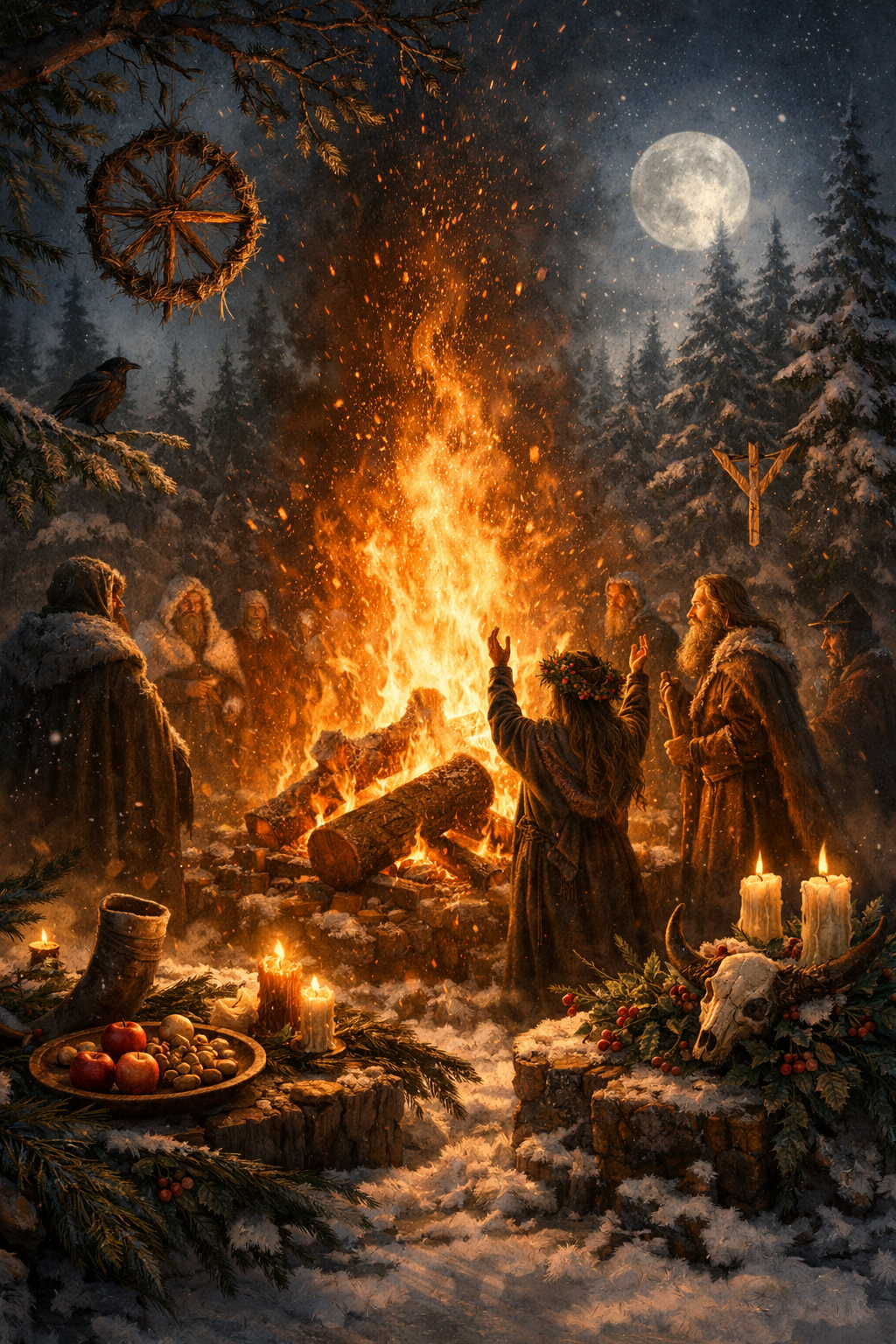
Yule, the story of the longest night and the return of the light
Winter slowly draws inward. Days grow shorter, nights lengthen, and the world falls silent. It is at this point of the year, at the moment of the winter solstice, approximately between December 21st and 22nd, that time once seemed to stand still in pre-Christian Europe. Not to celebrate abundance, but to remind people that even in the deepest darkness, the cycle turns and the light begins to return.

This moment was known by different names, yet its meaning remained strikingly similar. In the northern lands it was called Yule (Jól), while among the Slavs it took the form of winter turning festivals, today known as Kračun or the later Koleda. It was not a single day, but a period of transition, when the old year symbolically came to an end and the new one was only just being born.

Fire in the darkness

Across both the northern and Slavic worlds, fire was the central symbol of the winter solstice. In a landscape where darkness posed a real threat to life, fire represented the return of the sun in its most basic form. Large logs were lit, fires burned in courtyards and halls, and their flames were meant to last as long as possible.

In the northern tradition, references survive to the Yule log, whose fire was believed to protect the household and its livelihood. The ashes were kept as a protective element for the home and the fields. Similarly, among the Slavs, fire held a cleansing and protective role—it drove away harmful forces and symbolically strengthened the sun on its journey back.

Evergreens that endure the winter

Branches of trees that did not lose their color even in winter were brought into dark dwellings. Fir, pine, ivy, or holly were not mere decorations. They were proof that life had not disappeared, only withdrawn into rest.

This motif appears in both Germanic and Slavic traditions. Greenery protected the home, reminded people of nature’s resilience, and symbolically connected the human world to the cycle of the year. From here leads a direct path to later Christmas customs, which preserved this symbolism even as their meaning changed.

Feast, community, and vows

Yule was not a time of quiet contemplation alone. It was a time of community. People gathered, feasted, drank mead and beer, and strengthened the bonds on which survival through winter depended. The feast was not indulgence, but ritual—a confirmation that family and community stood together.

These gatherings also included vows and oaths. A new cycle called for decisions with the weight of commitment. It was believed that words spoken at this time carried special power.

Ancestors and the silence of the longest night

The winter solstice was also a time to turn toward those who were no longer among the living. It was believed that during the longest night, the boundary between worlds grew thinner. Among both northern peoples and Slavs, customs appear of leaving food for ancestors or household spirits who were meant to protect the home and family.

The silence of this night was not empty. It was filled with memory and with the awareness that life continues thanks to those who came before us.

A shared story of the winter solstice

Whether the festival was called Yule, Kračun, or by another name, its essence remained the same. It did not celebrate the triumph of light, but its return in its earliest form. It reminded people that darkness has its peak—and that change is born precisely there.

This story has survived centuries and, under various names, has left its mark on today’s Christmas traditions. Yet Yule retains its original strength: quiet, solemn, and deeply human.


We hope this text has inspired you to reconnect with one of the ancient traditions.

We wish you a bright fire, a silent night, and a certain return of the light.
 

ChatGPT Image 20. 12. 2025 23_37_20

Holiday & New Year Shipping Information

Dear beloved fans,

Starting today (December 17, 2025), we can unfortunately no longer guarantee that new orders from our e-shop will arrive before Christmas. We will continue shipping orders until December 22, 2025, after which we’ll be taking a short Christmas break. Orders placed after this date will be shipped again starting January 5, 2026.

If you’re planning last-minute gifts, please keep this timing in mind.
However, we can offer our digital products, which will be delivered to your email within 24 hours after purchase.

Thank you for your understanding and patience.

At the same time, we would like to thank you from the bottom of our hearts for the incredible support you’ve given us throughout 2025 — whether at concerts, festivals, or through our e-shop. Your messages, presence, and energy are what give our work meaning and keep us moving forward.

We wish you a calm and peaceful Christmas filled with light, warmth, and joy — and good health and plenty of great music in the New Year.

We look forward to seeing you again in 2026.

Your Deloraine merch team


OBR

Listing controls

4 items total