Winter slowly draws inward. Days grow shorter, nights lengthen, and the world falls silent. It is at this point of the year, at the moment of the winter solstice, approximately between December 21st and 22nd, that time once seemed to stand still in pre-Christian Europe. Not to celebrate abundance, but to remind people that even in the deepest darkness, the cycle turns and the light begins to return.
This moment was known by different names, yet its meaning remained strikingly similar. In the northern lands it was called Yule (Jól), while among the Slavs it took the form of winter turning festivals, today known as Kračun or the later Koleda. It was not a single day, but a period of transition, when the old year symbolically came to an end and the new one was only just being born.
Fire in the darkness
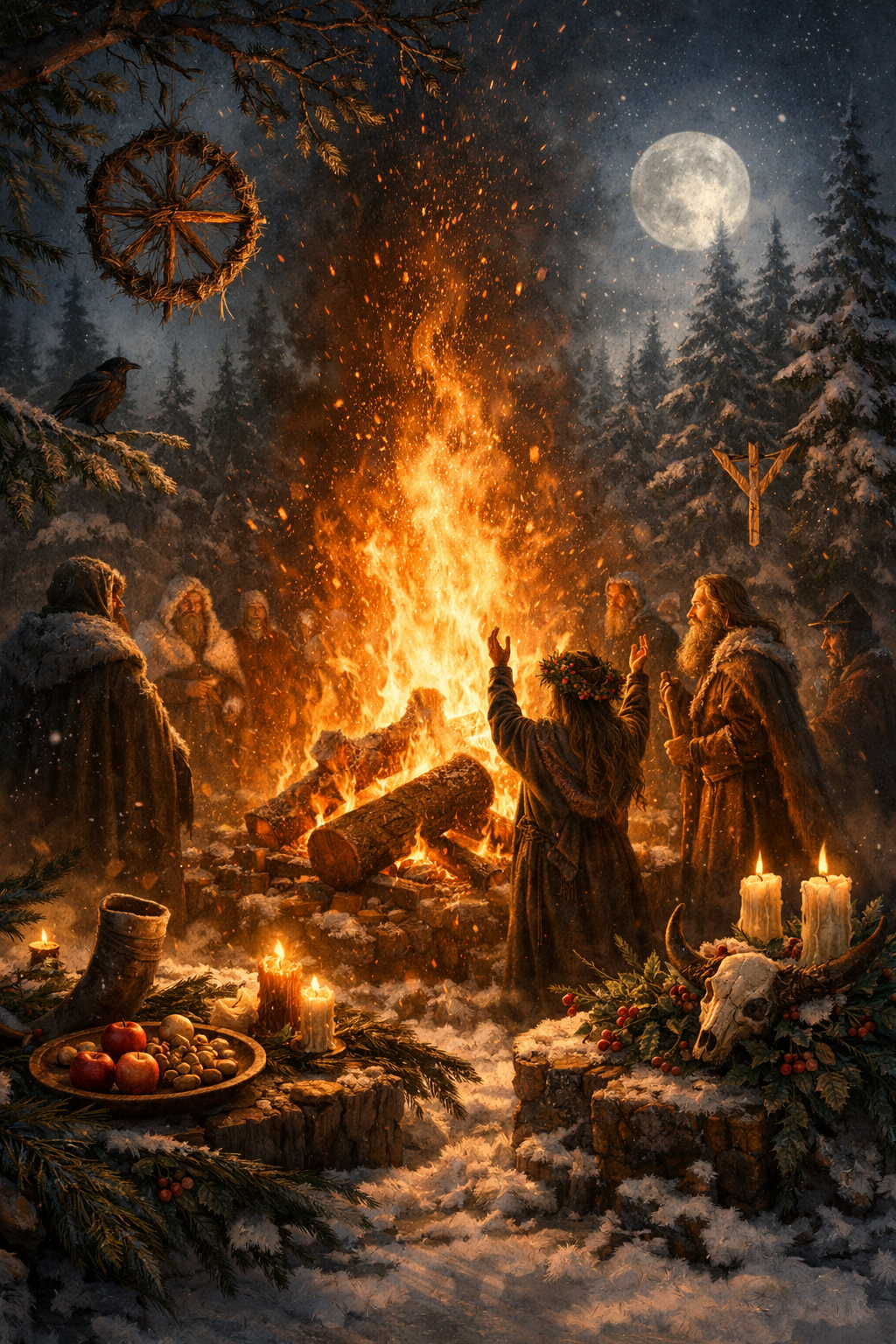
Across both the northern and Slavic worlds, fire was the central symbol of the winter solstice. In a landscape where darkness posed a real threat to life, fire represented the return of the sun in its most basic form. Large logs were lit, fires burned in courtyards and halls, and their flames were meant to last as long as possible.
In the northern tradition, references survive to the Yule log, whose fire was believed to protect the household and its livelihood. The ashes were kept as a protective element for the home and the fields. Similarly, among the Slavs, fire held a cleansing and protective role—it drove away harmful forces and symbolically strengthened the sun on its journey back.
Evergreens that endure the winter
Branches of trees that did not lose their color even in winter were brought into dark dwellings. Fir, pine, ivy, or holly were not mere decorations. They were proof that life had not disappeared, only withdrawn into rest.
This motif appears in both Germanic and Slavic traditions. Greenery protected the home, reminded people of nature’s resilience, and symbolically connected the human world to the cycle of the year. From here leads a direct path to later Christmas customs, which preserved this symbolism even as their meaning changed.
Feast, community, and vows
Yule was not a time of quiet contemplation alone. It was a time of community. People gathered, feasted, drank mead and beer, and strengthened the bonds on which survival through winter depended. The feast was not indulgence, but ritual—a confirmation that family and community stood together.
These gatherings also included vows and oaths. A new cycle called for decisions with the weight of commitment. It was believed that words spoken at this time carried special power.
Ancestors and the silence of the longest night
The winter solstice was also a time to turn toward those who were no longer among the living. It was believed that during the longest night, the boundary between worlds grew thinner. Among both northern peoples and Slavs, customs appear of leaving food for ancestors or household spirits who were meant to protect the home and family.
The silence of this night was not empty. It was filled with memory and with the awareness that life continues thanks to those who came before us.
A shared story of the winter solstice
Whether the festival was called Yule, Kračun, or by another name, its essence remained the same. It did not celebrate the triumph of light, but its return in its earliest form. It reminded people that darkness has its peak—and that change is born precisely there.
This story has survived centuries and, under various names, has left its mark on today’s Christmas traditions. Yet Yule retains its original strength: quiet, solemn, and deeply human.
We hope this text has inspired you to reconnect with one of the ancient traditions.
We wish you a bright fire, a silent night, and a certain return of the light.